How to make an offer on your first home in Victoria: private sale, auction, and the two conditions that protect you
The moment a shortlist becomes a signature. What goes in a written offer, why the standard finance and building conditions are narrower than buyers assume, what three clear business days of cooling-off actually buys you, and how the rules flip at auction. Told through Priya and Dan.
The short answer: in Victoria a home is sold one of two ways, and the rules are almost opposites. In a private sale you make a written offer through the agent, you can attach conditions (finance, a building inspection), and once you sign you usually have three clear business days to cool off. At auction there is no cooling-off, no conditions and a deposit due on the day, so everything protective has to happen before you raise your hand. The two conditions most first home buyers rely on are narrower than they look: the finance clause has a two-day window you must hit, and the building clause only covers major structural defects. Know that before you sign, not after.
See it in Havenli
Check the price against an independent estimate
Meet Priya and Dan, again
When we last sat with Priya and Dan, they'd worked out that the Seddon townhouse at $650,000 cost a good deal more than $51,000 extra, because it stepped them off Victoria's stamp duty exemption and onto the sliding scale. The Sunshine townhouse at $599,000 kept the duty at zero. They chose Sunshine, and the twelve extra minutes in the car.
Then came the part nobody had told them much about. Not finding the home, not affording it, but the week in which you turn "we like it" into a signed contract, and discover that a signature is where the real rules live.
Priya and Dan aren't real people, but their situation is. Every rule in this story is real and linked to its source below.
Two ways a home gets sold, two sets of rules
Before anything else, Dan checked how the Sunshine townhouse was being sold. It mattered more than he expected.
The Seddon place had been listed for auction on a Saturday. The Sunshine place was a private sale: a price guide, an agent, offers taken in writing. Victoria treats those two routes very differently, and the differences decide what protection you get, when your money becomes at risk, and how much homework has to be finished before you commit. Consumer Affairs Victoria spells out the private sale rules; the auction rules are on a separate page for a reason.
For a private sale the sequence is: written offer, negotiation, sign the contract, pay the deposit, cooling-off, conditions, settlement. For an auction it is: do all the homework, bid, and if you win, sign and pay the deposit right there. Priya and Dan were on the first track. We'll come back to what the second would have meant for them.
The written offer: what actually goes in it
A verbal "we'd pay 590" over the phone is a conversation, not an offer. In Victoria, only a written offer can lead to a binding contract of sale, and you make it through the agent, who must take it to the seller unless the seller has instructed otherwise (Consumer Affairs Victoria). In practice the agent hands you the contract of sale with your terms written into the particulars, and you sign that. So the offer is the contract. Read it that way.
Their offer on the Sunshine townhouse set out five things:
- The price. They opened below the guide, anchored to the comparable sales they'd already gathered, the way the research guide describes. A quiet open home had told them there was room.
- The deposit. The contract will usually say 10 per cent, but no law fixes the amount (Consumer Affairs Victoria), and Priya and Dan were buying with 5 per cent through the 5% Deposit Scheme. They offered a 5 per cent deposit, in writing, and the vendor accepted. Had they not asked, the contract would have asked them for $59,900 they did not have. Whatever the figure, the deposit is held in a trust account by the agent or the seller's conveyancer until settlement. It does not go to the seller.
- The settlement period. Commonly 30 to 90 days. They asked for 60, to land before the baby did and to give their scheme lender time. The agent had already said the vendor wanted a longer settlement, so it cost nothing.
- The conditions. Subject to finance, and subject to a building and pest inspection. More on both in a moment, because this is where buyers get caught.
- What comes with the house. The dishwasher, the heating unit, the blinds. If an item is not listed in the contract and you sign, Consumer Affairs Victoria's words are that "it may be difficult to claim ownership of those items at settlement." Fixtures are presumed to stay; anything that can be carried out is a question. Dan wrote them down.
The two conditions, and the traps inside them
Here is the part Priya and Dan nearly got wrong, and most first home buyers do: they assumed "subject to finance" meant if the bank says no, we're out, and "subject to building inspection" meant if the inspector finds something, we're out. Neither is quite true.
Subject to finance in the standard Victorian contract has mechanics. You can end the contract if the loan is not approved by the approval date written into the particulars, but only if you applied for the loan immediately, did everything reasonably required to get approval, are not otherwise in default, and serve written notice ending the contract within two clear business days after the approval date. Victorian practitioners' insurers describe this as requiring strict compliance, and lawyers have written up cases where buyers who missed the window lost six-figure deposits (Legal Practitioners' Liability Committee). The lesson is simple and unglamorous: put the approval date in your calendar, chase your lender before it, and if approval is not in hand, your conveyancer sends the notice that week, not after a few more days of hoping.
Because Priya and Dan were going through a participating scheme lender, their conveyancer pushed the approval date out to 21 days rather than the usual 14. The vendor agreed. It cost a sentence.
Subject to building inspection is narrower still. Under the standard condition you may end the contract within 14 days of signing, and only if a registered building practitioner or architect gives you a written report identifying a major structural defect and states in the report that it is major (Pearson Chambers, on the Victorian building inspection clause). A dated bathroom, a cracked path, rising damp in one corner, a long list of minor repairs: none of it lets you walk. So the condition is a safety net against the catastrophic, not a right to renegotiate over the ordinary. If you want the ordinary covered, your conveyancer can draft a special condition that says so, and the vendor can accept or refuse it. Ask for it before you sign, because afterwards it's too late.
Mel's inspection story made the point that an open home is not a building inspection. This is where the professional one happens: Priya and Dan booked an independent inspector for day four of their 14, never the agent's recommendation.
Havenli keeps track of all of this for you.
Honest answers, your numbers, every step of the journey — launching soon in Victoria.
Join the waitlistCooling-off: three clear business days, and what they cost
Once both sides have signed, most private sale buyers in Victoria get a cooling-off period of three clear business days. It runs from the day you sign, not the day the seller does. You exercise it by giving written notice to the seller or the seller's agent, and you get your money back less $100 or 0.2 per cent of the purchase price, whichever is greater (Consumer Affairs Victoria). On $599,000 that is $1,198. Not nothing, but a very cheap exit from a mistake.
Three clear business days means the day you sign does not count, and nor do weekends or public holidays. Priya and Dan signed on a Tuesday evening; their cooling-off ran Wednesday, Thursday and Friday, and ended when Friday did.
It does not apply to everyone. Cooling-off is excluded if you buy at a publicly advertised auction, or sign within three clear business days before or after one; if the property is mainly industrial or commercial; if it is more than 20 hectares used mainly for farming; if you previously signed a contract for the same property on the same terms; or if the buyer is an estate agent or a company (Consumer Affairs Victoria). The one that catches first home buyers is the first: a pre-auction offer, accepted in the final three business days before the auction, carries no cooling-off at all.
If it had gone to auction
That last exclusion is exactly where the Seddon townhouse would have taken them. The agent had suggested a pre-auction offer "before Saturday", which would have landed inside the no-cooling-off window. And had they waited for the auction itself, the whole protective structure above would have disappeared. At auction in Victoria (Consumer Affairs Victoria):
- There is no cooling-off period. The successful bidder signs a contract in the same terms that was on display before the auction, and cannot make it subject to any further conditions, finance or inspection included, unless the seller agrees.
- The deposit, usually 10 per cent, is payable when you sign, which is immediately after the hammer falls.
- The auction rules must be on display for at least 30 minutes before the auction starts, and the auctioneer must tell bidders how it will run. Vendor bids are allowed only if the rules say so, can only be made by the auctioneer, and must be announced as vendor bids. Dummy bidding is illegal.
- Once bidding reaches the reserve, the property is "on the market". If it does not, it is passed in, and the highest bidder gets the first right to negotiate a price with the seller. If they cannot agree, the agent may approach other bidders.
So an auction buyer does everything a private sale buyer does after signing, before the day instead: finance approved, not just pre-approved; building and pest report in hand; the Section 32 and contract reviewed by a conveyancer; and a walk-away number decided while calm. Money spent on a property you then don't win stings. It is cheap compared with an unconditional contract on a property with a problem.
The document you read before you sign anything
Whichever route you are on, one document comes before the signature: the Section 32 vendor's statement. It is the seller's legally required disclosure of things that are not visible at an open: restrictions such as covenants and easements, outgoings such as rates, and notices such as a compulsory acquisition (Consumer Affairs Victoria). The government's own due diligence checklist says to request both the contract and the Section 32 and read them thoroughly.
Read them, yes. But have your conveyancer read them first. Priya and Dan sent both documents over the night the agent emailed them, and had a conveyancer's notes back before they signed: an easement along the rear boundary for drainage, owners corporation fees for the shared driveway, nothing alarming, two things they would not have spotted. Finding a conveyancer at this moment is one of the places Havenli hands you to the right professional.
How it played out
Their first written offer was below the guide and the vendor said no. Their second, a little higher with the 60-day settlement the vendor wanted, was accepted on a Tuesday. Five per cent deposit into the agent's trust account. Cooling-off ran to Friday; they did not need it. The building inspector came on day four and found a townhouse built like a townhouse: a couple of minor things, nothing major, nothing that triggered anything. Finance approval arrived on day 17, four days inside the 21 their conveyancer had negotiated.
The question that got them through wasn't "how much should we offer?" It was quieter, and they asked it before they signed rather than after: what, exactly, lets us out of this if something goes wrong, and by when? Once they could answer that, the contract stopped being frightening and became a list of dates.
What happens between that Friday and the keys is its own story: your offer was accepted, now what?
If you're like Priya and Dan
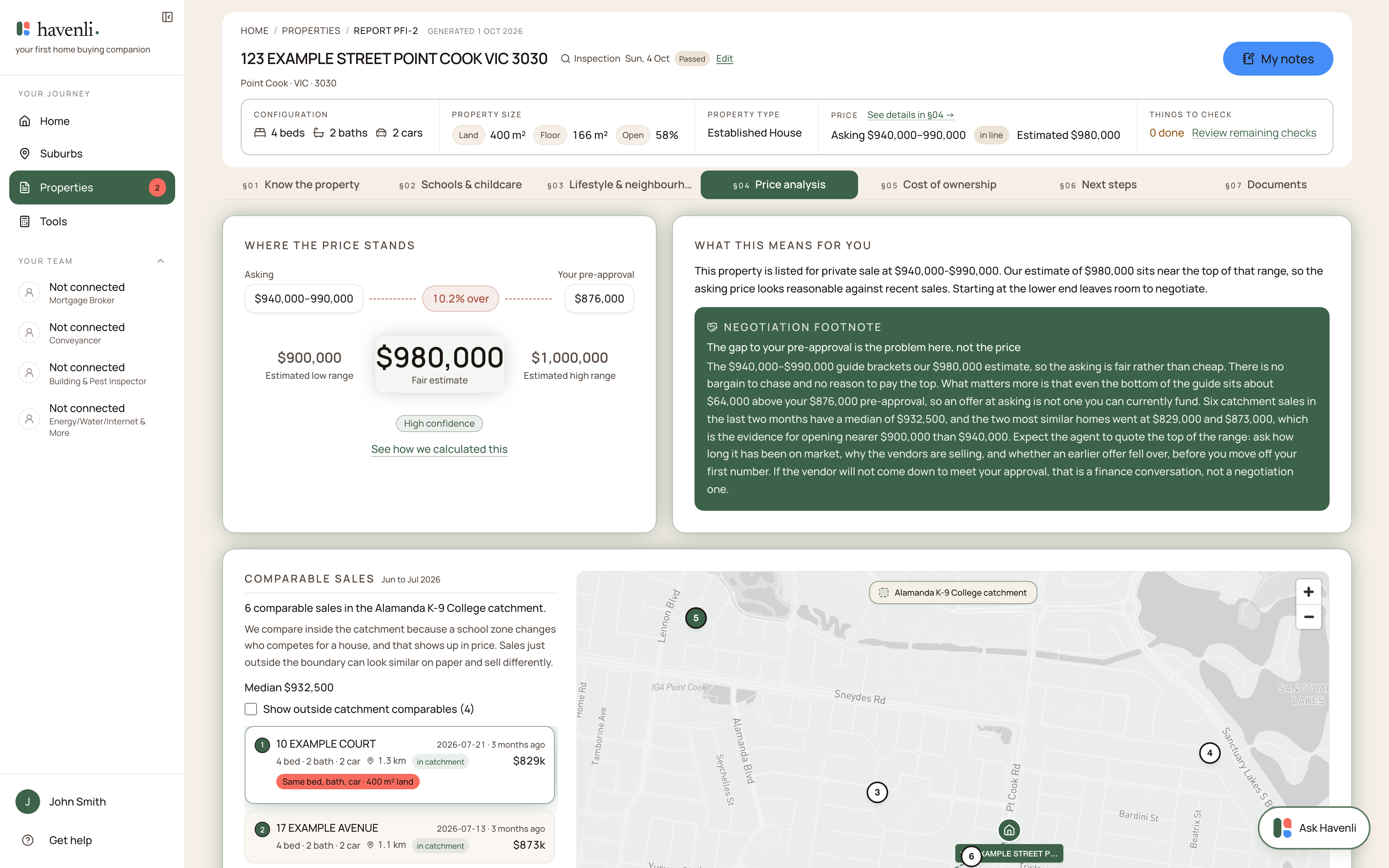
This is where Havenli's price analysis earns its place: what the property could be worth from comparable sales, so your opening number is evidence rather than nerves, and what the agent's price guide is doing relative to those sales. Then the mechanics, personalised to the property: whether it's a private sale or an auction, which conditions to ask for, the approval date to put in your calendar, and a conveyancer to read the Section 32 before you sign. See how Havenli works, go back to what the $51,000 gap really cost them, or read how to know a property's true value before you buy.
This story is general information, not financial, legal or real estate advice. Priya and Dan aren't real people, their numbers are illustrative, and your circumstances will differ. Contract conditions, cooling-off rules and auction rules change, and the standard contract's wording is what binds you; always confirm the current details with the official sources linked above, and have a licensed conveyancer or solicitor review any contract before you sign it.
Frequently asked questions
How do I make an offer on a house in Victoria?
Through the agent, in writing. Only a written offer can lead to a binding contract of sale, and the agent must pass your offer to the seller unless the seller has told them not to. The offer sets out your price, the deposit, the settlement period, any conditions, and the items you expect to come with the property.
What is the cooling-off period when buying a house in Victoria?
Three clear business days, counted from the day you sign the contract, not the day the seller signs. You withdraw by giving written notice to the seller or their agent, and you get your money back less $100 or 0.2 per cent of the price, whichever is greater. It does not apply at auction, or to a contract signed within three clear business days either side of a publicly advertised auction.
Does "subject to finance" let me walk away if my loan falls through?
Only if you follow the clause exactly. Under the standard Victorian contract you must have applied for the loan promptly, done everything reasonably required to get it, and serve written notice ending the contract within two clear business days after the approval date. Miss that window and the condition lapses, and buyers have lost deposits that way.
Does "subject to building inspection" cover any problem the inspector finds?
No. The standard condition lets you end the contract within 14 days of signing only if a registered building practitioner or architect gives you a written report identifying a major structural defect and says so in the report. A dated kitchen, a cracked path or a long list of minor repairs does not qualify.
Is there a cooling-off period if I buy at auction in Victoria?
No. The contract is unconditional when the hammer falls, you cannot add finance or inspection conditions unless the seller agrees, and a deposit, usually 10 per cent, is payable when you sign on the day. That is why finance, the building inspection and the contract review all have to be done before auction day.
What happens if a property is passed in at auction?
If bidding does not reach the reserve, the property is passed in and the highest bidder gets the first right to negotiate a price with the seller. If they cannot agree, the agent may approach other bidders.
A friend in your corner while you buy your first home.
Havenli gives first home buyers honest, sourced answers — from your first listing scroll to the keys. Launching soon in Victoria.
Join the waitlist