Know a property's true value before you buy: a first home buyer's research guide (Victoria, 2026)
A property's true value is more than its price. The complete research checklist for first home buyers — the home itself, the schools, what daily life really feels like, a fair price, the true cost to own, and your next steps — with the government sources to check each one yourself.
The short answer: a property's true value is not the number on the price guide. It's the sum of six things you can research before you ever fall for it: the property itself (history, overlays, what the listing hides), the school and childcare picture, what daily life there actually feels like, whether the price is fair, what it truly costs to own, and what happens next if you decide to offer. Most of it is checkable from your couch, free, from government sources. This post shows you how, step by step.
Ask most people what a property is "worth" and they'll point at a number — the price guide, the last sale, an estimate on an app. But that number is the narrowest possible reading of value. A home you can afford and genuinely want to live in is worth far more to you than a marginally cheaper one that adds an hour to every commute, buries you in owners-corporation levies, or sits in a bushfire overlay you didn't know to look for.
The listing won't close that gap for you. It gives you photos, a price guide and adjectives. None of them tell you the home was tenanted for the last two years, sits in a growth zone earmarked for apartments, is zoned for a school 4 km away, or is asking less than it sold for a decade ago. That last one sounds like a bargain — until you ask why.
So this guide treats value the way it actually works: the fair price and everything around it. Six dimensions, in the order the decision unfolds, each one checkable before you lose a weekend — or your heart — to a place.
See it in Havenli
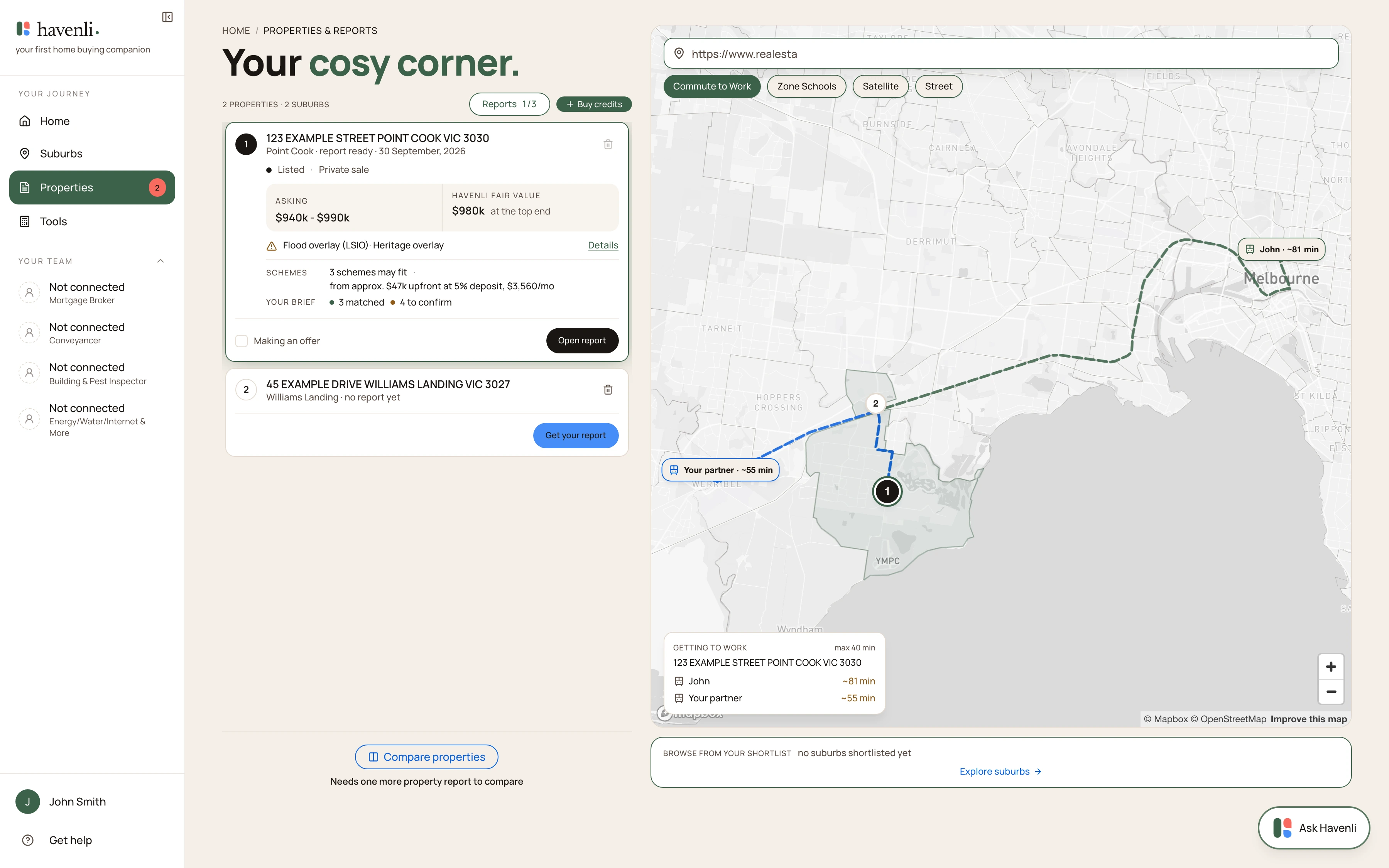
Open any report from your list
1. Know the property: what the listing doesn't tell you
Who has lived here, and how? Look up the last sale date and price, then think about what's happened since. A home that was owner-occupied for nine years and then rented out for the last two often shows rental wear. Pay closer attention to finishes, appliances and maintenance at inspection. A property being sold soon after purchase is worth a "why?".
Planning overlays: the four that matter. Flood, bushfire, heritage and contamination overlays affect what you can build, what you'll pay to insure, and in some cases whether you should buy at all. Check them free on VicPlan / Vicmap Planning: type the address and read every overlay code that appears. While you're there, note the zone. A Residential Growth Zone, for example, means the area is set up for more density, so the quiet street of today may be townhouses in ten years. That's not automatically bad, but it should be a decision you make, not a surprise you inherit.
Features vs your must-haves. A north-facing balcony is lovely, unless what you actually need is a backyard. A "2-bed with open-plan living" is fine, until you remember you both work from home and there's no study. Write down your non-negotiables before the inspection and score the listing against them coldly. The listing is written to sell; your checklist is written to decide.
Heating, cooling and running costs. "Heating" in a listing can mean anything from efficient reverse-cycle to an ageing gas ducted system heading into its expensive years. If the type isn't disclosed, ask. In Victorian winters, that answer changes your bills materially.
What to confirm on paper. Before you offer: that the car space and any storage are actually on title (not a licence), and that the Section 32 doesn't hide easements, covenants or notices tied to those overlays. You can order the title, plan of subdivision and other official records yourself from Landata.
What to ask the agent. Four questions that earn their place in every conversation: Are there any known building defects or rectification works (and special levies for them)? If tenanted, when does the lease expire and can vacant possession be offered at settlement? When were the bathroom, kitchen and flooring last renovated? And exactly what's included in the sale beyond fixtures?
In a Havenli property report, all of this is section one: ownership and tenure history, every overlay on the site in plain language, the listing's features scored against your stated must-haves, and a ready-made "check these yourself / ask the agent" checklist you can tick off as you go.
2. Schools and childcare: the zone is part of the price
If children are in your present or your plans, the school zone is effectively welded to the property — and welded to its value. In Victoria, a child living at an address has guaranteed entry to the zoned government school, and nowhere else is guaranteed. Check the exact catchment for any address at FindMySchool (Vic Department of Education). Do this before you fall for the house: "near a great school" and "zoned for a great school" are very different sentences, and the difference is often a single street.
Beyond the zone, map the childcare picture: long day care and kindergarten availability nearby, their NQS ratings (Exceeding / Meeting National Quality Standard; check any service on StartingBlocks), and before/after school care if you're juggling work hours. Distances matter more than they look on a map. A 2.6 km childcare run in peak traffic, twice a day, is a lifestyle decision — and a cost in hours you'll pay every week.
Havenli's report resolves the exact DET catchment for the address, then lists nearby childcare, kindergarten and outside-school-hours care with their NQS ratings and distances, personalised to the ages of your children.
3. Neighbourhood and lifestyle: what living here actually feels like
This is where much of a property's true value hides — and where none of it shows up in the price guide. Two identical floorplans can be worth wildly different amounts to you, and the difference is almost never in the building; it's around it. You inspect on a sunny Saturday morning. You'll live there on a wet Tuesday in July. Research the Tuesday:
- The commute, at peak. Not the distance, the time, for the hours you actually travel, for both of you if you're a couple. Run it on Google Maps with "arrive by" set to your real start time.
- How car-dependent is daily life? A Walk Score above ~80 means errands genuinely happen on foot; below ~50 means the car is part of every plan. Check the address on Walk Score.
- Public transport frequency, not just proximity. A tram stop 140 m away that runs every 6 minutes is a different life from a bus 140 m away that runs every 40.
- The everyday radius. Supermarket, GP, pharmacy, a park, somewhere for coffee: within what distance? These are the trips you'll make hundreds of times a year.
- Crime, from the source. Skip the forum threads; the Crime Statistics Agency Victoria publishes recorded offences by suburb, with trend. Compare against neighbouring suburbs rather than reading any number in isolation.
Havenli pulls all of this into one view: your actual commutes at peak and off-peak, walk and transit scores, the nearest of everything, and official crime statistics with context, written as a plain-language picture of what living there is like for your household.
Havenli keeps track of all of this for you.
Honest answers, your numbers, every step of the journey — launching soon in Victoria.
Join the waitlist4. Fair price: what it's worth on paper
This is value in its narrowest sense — what the market would likely pay. It matters enormously, but it's one input, not the whole verdict. The price guide, meanwhile, is the vendor's opening position, not a valuation. To form your own view:
Find true comparables. Recent sales (last 12 months) of properties with the same beds, baths and parking, as close as possible, ideally inside the same school catchment, because the zone is part of what you're paying for. Three to five good comps beat twenty loose ones. If the comp pool is thin, treat any estimate, anyone's, with extra care.
Check the property's own price history. What did it last sell for, and when? Prices generally trend up over time, so an asking price below the last sale is unusual. Sometimes it's a motivated seller, which is negotiating power for you. Sometimes it's a signal something is worth investigating. Cheap isn't a reason on its own.
Anchor your negotiation to evidence, not the guide. Decide your fair-value number from the comps, open the conversation near the bottom of your band, and let inspection turnout tell you how firm you can be: a packed open home means less room; a quiet one means more.
And anchor your budget to you, not the property. Two of the most common money mistakes first home buyers make: treating the property's price as their budget, and treating the bank's pre-approval as their spending ceiling. Both push you to your financial edge by default. We cover these and ten more in 12 mistakes first home buyers make.
Havenli's report builds an independent estimate from same-school-zone sales, shows you every comp it used and how similar each one really is, flags anomalies like asking-below-last-sale, and is honest about confidence when the data is thin, because a low-confidence estimate presented confidently is how buyers get burned.
5. Cost of ownership: the price is not the cost
A price you can afford and a cost you can't are two different properties. Two sets of numbers the listing never shows:
Upfront, before settlement. Beyond the deposit: stamp duty (unless an exemption applies to you), conveyancing, building and pest inspection, title searches, registration fees, a removalist, utility connections. These add up to real money on top of the deposit, and underestimating them is one of the most common ways buyers get caught short at settlement. For the full breakdown of what you'll need saved and when, read how much deposit you actually need for a first home in Victoria.
The schemes: check every one. Depending on your situation, you may qualify for stamp duty relief, a low-deposit guarantee that removes LMI, or help building your deposit through super. The eligibility rules and caps change over time, so rather than quoting figures that will age, we keep them current in one place: the complete guide to first home buyer schemes in Australia. Just as important: know which schemes don't apply to you. Ruling schemes out is as useful as ruling them in.
Monthly, ongoing. Mortgage repayment is the headline, but add council rates, water, energy, internet, insurance, maintenance, and for units, owners corporation fees, which vary enormously and are set by the building, not by you. A "cheaper" apartment with high strata can out-cost a dearer one with low strata. Ask for the OC certificate early.
Havenli's report runs every scheme against your actual situation, showing the calculation, not just the verdict, and lays out upfront and monthly costs for the specific property, with a "try your own numbers" mode. And because these are estimates, it says so, plainly: confirm with a broker and conveyancer before you commit.
6. Next steps: from "I like it" to keys
Research isn't the end; it's what makes the next five steps safe:
- Finance and eligibility check (roughly 1 to 3 weeks from scratch). Talk to a mortgage broker before you offer. They confirm borrowing power against this specific property and validate the schemes above.
- Physical inspection (see our companion guide: what to know before a house inspection). Data can't smell damp or feel light. The inspection is where the report meets reality.
- Make your offer, and know which rules apply.
- Private sale: offer in writing with subject-to clauses. Subject to finance and subject to building & pest give you a clean exit if something material surfaces, and Victorian private treaty sales carry a 3-business-day cooling-off after signing (a penalty applies if you withdraw: 0.2% of the price or $100, whichever is greater; see Consumer Affairs Victoria).
- Auction: the rules flip completely. There is no cooling-off at auction, and no cooling-off if you sign within 3 clear business days before or after one. The contract is unconditional the moment the hammer falls: no subject-to-finance, no subject-to-inspection. That means everything moves before auction day: have your conveyancer review the Section 32 and contract, get your building & pest inspection done, and have finance fully approved, all before you raise your hand. Money spent on a property you don't win stings, but it's cheap insurance against an unconditional contract on a property with problems.
- Post-offer (private sale), three things in parallel: Section 32 + contract to a conveyancer; an independent building & pest inspector (never the agent's recommendation); and for units, the OC ledger, recent AGM minutes and any planned special levies.
- Final offer, sign, settle. Most Victorian settlements now run electronically via PEXA, and you have the right to a pre-settlement walk-through in the final week to confirm nothing has changed.
Havenli's report closes with this exact playbook, personalised, including the questions still open for your specific property, and connections to a verified broker and conveyancer at the moment you actually need them, not before.
What research can't check
Honesty matters here: no report, ours included, can check physical defects only visible on a walk-through, neighbour and body-corporate dynamics that haven't surfaced in minutes yet, future planning applications nearby, or title-level issues like caveats (your conveyancer's job). Desktop research narrows the risk; the inspection, the B&P report and the conveyancer close it. Use all four.
Value isn't one number. It's whether all six of these — the home, the schools, the daily life, the price, the cost and the path to settlement — line up for your life. Research is how you find out before you're committed, not after.
General information only, not financial, legal or credit advice. Scheme eligibility has conditions that must be confirmed for your situation. Always engage a licensed mortgage broker, conveyancer and building inspector before committing to a purchase.
Frequently asked questions
Is a property's value just its price?
No. The price is what the market would pay — the narrowest reading of value. A property's true value to you also depends on its condition and planning risks, the school zone, what daily life there actually feels like, and the real cost to own it. A cheaper home that adds an hour to your commute or sits in a flood overlay can be worth far less to you than a dearer one that fits your life.
What should I check before buying a house in Victoria?
Six things — the property's history and planning overlays, the school catchment, the day-to-day liveability (commute, transport, amenities, crime), whether the price is fair, the full upfront and ongoing costs including scheme eligibility, and the offer-to-settlement process ahead. Each is checkable via free government sources: VicPlan, FindMySchool, the Crime Statistics Agency, SRO Victoria and Landata.
How do I check a property's flood or bushfire risk in Victoria?
Search the address on VicPlan (Vicmap Planning) and read the overlay codes. Flood (LSIO/SBO/FO), bushfire (BMO/BPA), heritage (HO) and contamination (EAO) overlays all appear there, free.
How do I find which school a property is zoned for?
FindMySchool (Victorian Department of Education) shows the exact government primary and secondary catchment for any address. Zone boundaries can change between streets, so check the address, not the suburb.
Is a property priced below its last sale a bargain?
Sometimes. A seller under time pressure gives you negotiating power. But prices generally trend up, so asking-below-last-sale is unusual enough to investigate before you celebrate. Only proceed if you genuinely like the home; cheap isn't a reason on its own.
Is there a cooling-off period when buying at auction in Victoria?
No. Cooling-off does not apply to auction purchases, or to contracts signed within 3 clear business days either side of an auction. The contract is unconditional when the hammer falls, which is why your conveyancer review, building and pest inspection and full finance approval must all happen before auction day.
Should I get a building and pest inspection before an auction?
Yes, if you're serious about bidding. Because an auction contract has no subject-to-inspection clause, the inspection has to happen beforehand. If you don't win, the money spent still bought you protection against an unconditional purchase of a property with hidden problems.
What does an owners corporation (strata) fee cover, and why does it matter?
OC fees fund the building's shared upkeep, insurance and administration. They vary widely between buildings and directly change your monthly cost of ownership, so ask for the OC certificate, recent AGM minutes and any planned special levies before you offer.
Can I do all this research without paying for reports?
Mostly, yes. VicPlan, FindMySchool, StartingBlocks, the Crime Statistics Agency and Consumer Affairs Victoria are free. Landata charges for official title documents. The trade-off is time — gathering and interpreting it all per property takes hours, which is the job Havenli's property report does in minutes.
A friend in your corner while you buy your first home.
Havenli gives first home buyers honest, sourced answers — from your first listing scroll to the keys. Launching soon in Victoria.
Join the waitlist