Your offer was accepted. Now what? From contract to keys in Victoria
The eight weeks nobody explains: when a contract goes unconditional, the finance approval date a self-employed borrower cannot afford to miss, the deposit release request you can refuse, insurance from the day the vendor signs, what your conveyancer is actually doing, electronic settlement, and the 12-month rule attached to your stamp duty concession. Told through Hannah and Leo.
The short answer: between "congratulations" and the keys there is usually a month or two in which your contract goes from conditional to unconditional, a finance approval date you must not drift past, a deposit sitting in a trust account where the seller may ask for it early (you can say no), a house you insure before you own it, and a conveyancer doing most of the real work. Then, on the day, the money, the title and the keys change hands electronically. And one thing follows you home: the stamp duty concession that saved you thousands comes with a 12-month residence requirement. Here is the sequence, in order, with the dates that matter.
See it in Havenli
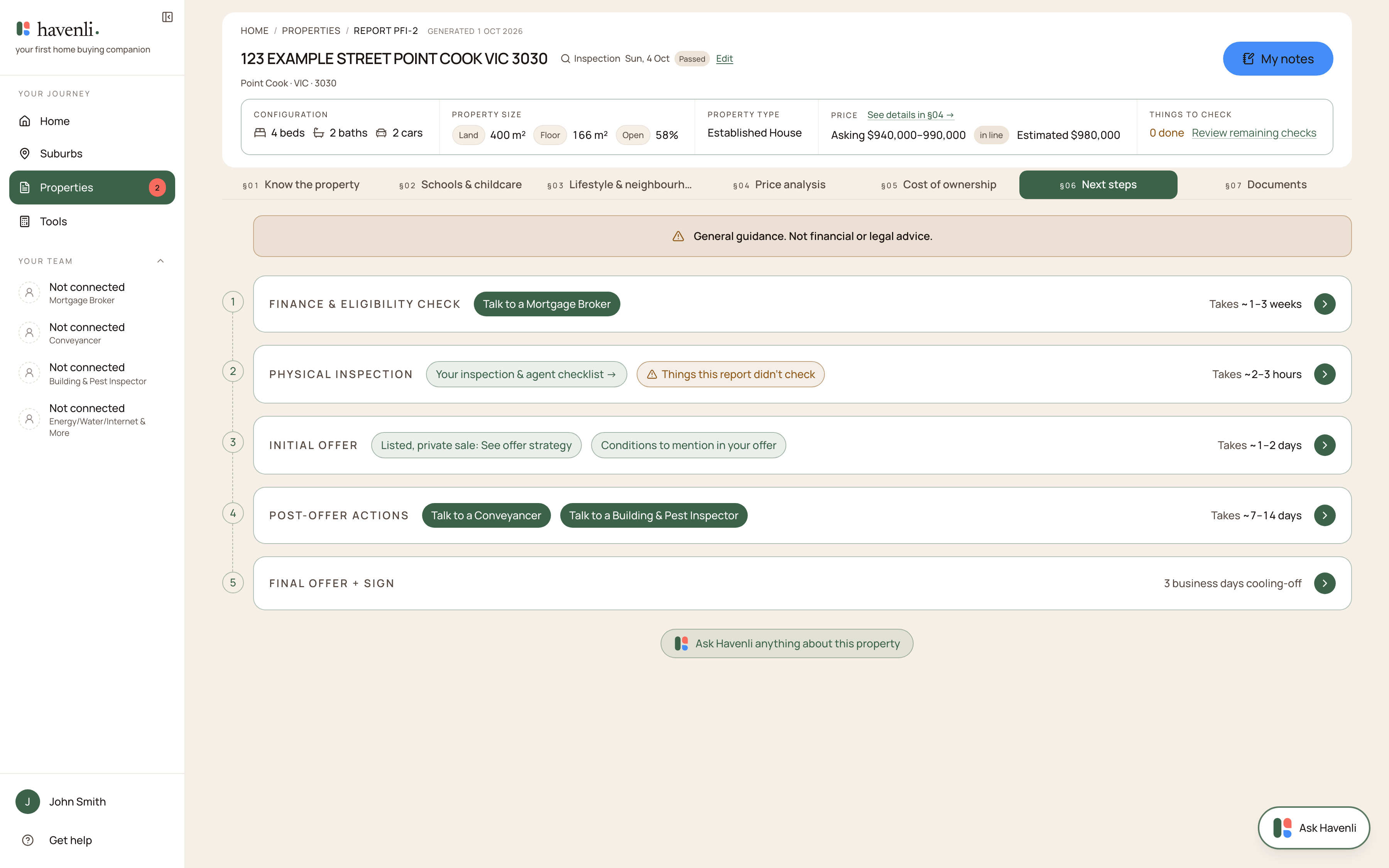
Follow every step from offer to keys
Meet Hannah and Leo, again
When we last sat with Hannah and Leo, a broker had found a lender that read Leo's self-employed carpentry income properly and had a 5% Deposit Scheme place. They'd been approved for a number that flattered them and had decided, on purpose, to borrow below it. Since then they'd found a two-bedroom townhouse with a strip of courtyard in Melbourne's east, listed at $715,000, and their written offer had been accepted on a Thursday: a 5 per cent deposit of $35,750, a 60-day settlement, subject to finance and a building inspection.
Cooling-off ran to the following Tuesday. They didn't use it. Then Leo, who builds things for a living and is used to knowing what happens next, asked the question every buyer asks the day after: so what happens now?
Hannah and Leo aren't real people, but their situation is. Every rule in this story is real and linked to its source below.
Week one to three: conditional becomes unconditional
A contract with conditions in it is a contract either side might still get out of. Hannah and Leo's had two, each with a date, and the next three weeks were about those dates.
The building inspection came first. Under the standard Victorian condition they had 14 days from signing, and only a written report identifying a major structural defect would have let them end the contract, as the offer story explains. Leo went to the inspection himself, which inspectors tolerate and carpenters cannot resist. Nothing major. The condition passed quietly on day 14.
Finance was the one that nearly bit. Their contract had a 14-day approval date, which is common. Their lender's assessment of Leo's income was not. Even with the broker's groundwork, the credit team wanted his latest quarterly activity statement, three months of business bank statements and an updated accountant's letter, and each request arrived a few days after the last. By day 11 the file was still "with the assessor".
This is the point at which the standard contract is unforgiving. A buyer can end the contract for want of finance only if they applied for the loan immediately, did everything reasonably required, are not otherwise in default, and serve written notice within two clear business days after the approval date. Victoria's lawyers' insurer describes it as requiring strict compliance, and has written up cases where buyers who waited a few extra days lost six-figure deposits (Legal Practitioners' Liability Committee). Hope is not a strategy here. A date is.
The contract also says the approval date can be pushed to any later date allowed by the vendor, so on day 12 their conveyancer asked, in writing, for seven more days. The vendor agreed the same afternoon; a vendor who has already waited two weeks rarely wants to start again. Unconditional approval arrived on day 19, inside the extended date. Had it not, the conveyancer's instruction was already drafted: the notice goes on day 22 or 23, not after another week of chasing.
With both conditions satisfied, the contract was unconditional. That word changes two things. Neither side can walk under a condition any more. And the deposit, which until then would have come back to Hannah and Leo if a condition failed (Consumer Affairs Victoria), is now at risk if they fail to settle. Their $35,750 had stopped being refundable and started being a promise.
Week four: the deposit release request
Around day 30 the agent emailed: would Hannah and Leo agree to release the deposit to the vendor early?
Most buyers have never heard of this and assume they must say yes. They do not. In Victoria a deposit can be released to the seller before settlement only if the buyer agrees, and only when three things are true: the contract is unconditional, it is at least 28 days since the contract was signed, and the seller has shown, with proof, that debts secured against the property are no more than 80 per cent of the sale price (Consumer Affairs Victoria). Otherwise the deposit stays exactly where it was: in the agent's or conveyancer's trust account, until settlement.
Their conveyancer's advice was to decline. Releasing early does nothing for the buyer, and keeping the deposit in trust until the day everything completes is the whole point of a trust account. They said no, politely, in writing. The vendor's agent moved on.
Insure a house you don't own yet
This one surprised Hannah. Their lender asked for building insurance effective from the date the seller signed the contract, not from settlement, which is exactly what Consumer Affairs Victoria says lenders will recommend. The reasoning is blunt: if the townhouse burned down in week five, they were contractually bound to buy whatever was left, and the lender wanted its security insured. She arranged cover that week and sent the certificate to the conveyancer for the lender's file.
Havenli keeps track of all of this for you.
Honest answers, your numbers, every step of the journey — launching soon in Victoria.
Join the waitlistWhat your conveyancer is actually doing
"Your conveyancer will take it from here" covers a lot of quiet work. Over the 60 days theirs:
- Checked the title and the boundaries against the Certificate of Title, which Consumer Affairs Victoria lists among the buyer-side pre-settlement checks.
- Prepared the transfer and the settlement statement, which is where every number meets: the price, the deposit already paid, the adjustments, the duty, and the balance the lender and Hannah and Leo had to produce on the day.
- Adjusted the outgoings. Council rates, water and the owners corporation fees for the shared driveway are split between seller and buyer at settlement, so each pays for the days they owned (Consumer Affairs Victoria).
- Handled the stamp duty paperwork. At $715,000 they sat on the slope Priya and Dan had avoided: above the $600,000 line where first home buyers pay nothing, below the $750,000 line where the concession runs out, so they paid a reduced duty under Victoria's first home buyer concession, as the stamp duty story explains. The conveyancer claimed the concession as part of the settlement, lodged electronically. Had they been buying a new home, the First Home Owner Grant would usually be lodged by the lender, and must be applied for within 12 months of settlement; it did not apply to their established townhouse.
- Set up the electronic settlement. Victoria moved property settlements online in 2018, so there is no room full of people with cheques. The conveyancers and lenders complete it on a platform (Consumer Affairs Victoria), and the money, the duty and the title registration move together at a booked time on the day.
None of this needed Hannah or Leo. What it needed from them was answering emails the same day, and getting the balance of their funds into the right account before the deadline the conveyancer gave them, which was earlier than settlement day itself.
The final week: the inspection you are entitled to
In Victoria a buyer is entitled to inspect the property at any reasonable time during the week before settlement, and the seller must hand it over in the same condition as when it was sold (Consumer Affairs Victoria). Leo went on the Wednesday with the contract's list of what came with the house and the inspection report from week one, and found everything where it should be, with one cracked tile by the back door that had not been cracked before. He photographed it, the conveyancer requested a repair, and the vendor had it done by the Friday.
What the final inspection can and cannot do for you, and what happens when a vendor says no, is a story of its own: the pre-settlement inspection, and what to do if something is wrong.
Settlement day
Day 60 fell on a Monday. Settlement was booked for 2pm.
Here is what settlement is, in Consumer Affairs Victoria's plain terms: the date you pay the balance of the purchase price, get the property title and become the registered owner, and take possession, with rates and other charges adjusted between you and the seller (Consumer Affairs Victoria). It is conducted between the two sides' conveyancers and the lenders. Hannah was at work. Leo was on a job site in Ringwood with his phone face up on a sawhorse.
At 2:35pm the conveyancer rang: settled. The lender had paid the loan funds, their own balance had gone with it, the deposit had been released from trust to the vendor at last, the duty concession had been claimed, and the title was in their names. Once settlement is completed, you can collect the keys from the agent. Leo knocked off early for the first time in a year.
After the keys: what you can and can't fix
A home that is yours is, mostly, your problem now. Consumer Affairs Victoria's page on building problems after settlement sets out the exceptions, and they are specific: statutory building warranties cover building work for up to 10 years after its occupancy permit or certificate of final inspection, and the builder's domestic building insurance covers work worth more than $16,000 for six years if the builder has died, disappeared or become insolvent. Useful if your home is recent or recently renovated. Not much use for a 2000s townhouse with its original hot water service, which is why Leo had looked at it so hard in week one.
Which is the honest point of the whole sequence above. The building inspection, the Section 32 review and the final inspection exist because after settlement there is very little to appeal to. Every protection is front-loaded. Use it while it is still there.
The rule that follows you home
One obligation does not end at settlement. The first home buyer duty concession that reduced Hannah and Leo's duty requires them to live in the property as their principal place of residence for 12 continuous months, starting within 12 months of settlement (State Revenue Office Victoria). It is the same requirement whether you got the full exemption or the concession, and the same 12-month rule attaches to the First Home Owner Grant for buyers of new homes. Move in, stay a year. Rent it out instead, or circumstances change and you can't meet the requirement, and the concession can be reassessed. For a couple who had chosen their repayment so a quiet quarter for Leo would not force a sale, it was the easiest condition of the lot.
How it played out
Sixty days, one near miss, and one decision: to ask for seven more days in writing on day 12 rather than hope on day 14, and to say no to one email on day 30. Everything else was dates: 14 for the building condition, 21 for finance once extended, 28 before anyone could even ask about the deposit, the week before settlement for the inspection, 2pm on day 60. The conveyancer carried the paperwork; the lender carried the money; the two of them carried a list and a camera.
The question that kept them steady wasn't "is everything going to be alright?" It was quieter and far more answerable: what is the next date, and what do we need to have done before it? Asked that way, eight weeks of waiting turned into five small jobs, and a self-employed income that had made the first bank nervous turned out to be the easiest part of the whole thing to prove, given a week to prove it.
If you're like Hannah and Leo
This stretch is what Havenli's next-steps guidance is for: your contract's actual dates turned into a personal timeline, the approval date flagged early enough to ask for more time rather than scramble, a reminder that you can decline the deposit release request and why, the insurance you need before you own anything, and the two lists to walk in with on the final week. And when a Section 32, a settlement statement or a letter from the owners corporation lands in your inbox, Ask Havenli explains what it is, in plain words, and what, if anything, you need to do about it. See how Havenli works, go back to broker or bank, or read how Priya and Dan made their offer.
This story is general information, not financial, legal or real estate advice. Hannah and Leo aren't real people, their numbers are illustrative, and your circumstances will differ. Contract conditions, deposit rules, duty concessions and residence requirements change, and the terms of your own contract are what bind you; always confirm the current details with the official sources linked above, and engage a licensed conveyancer or solicitor for your purchase.
Frequently asked questions
What does it mean when a property contract goes unconditional?
Every condition in the contract has been met or has lapsed, so neither side can walk away under them. For a buyer that usually means finance is approved by the approval date, the building inspection period has passed without a major defect, and cooling-off has ended. From that point the deposit is at risk if you fail to settle.
What if my finance is not approved by the approval date?
Under the standard Victorian contract you can ask the vendor to allow a later date, and vendors often agree. If approval is not in hand and no extension is granted, you can end the contract only by serving written notice within two clear business days after the approval date, and only if you applied immediately and did everything reasonably required. Miss that window and the condition lapses.
Can the seller get the deposit before settlement in Victoria?
Only with the buyer's agreement, and only once the contract is unconditional, at least 28 days after it was signed, and after the seller has shown that debts secured against the property do not exceed 80 per cent of the sale price. You can decline the request and the deposit stays in trust until settlement.
When should I insure a house I am buying in Victoria?
Your lender will recommend building insurance effective from the date the seller signs the contract, and will usually require it before settlement. Do not wait until settlement day.
What actually happens on settlement day?
You pay the balance of the purchase price, the title transfers to you and you become the registered owner, and rates and other outgoings are adjusted between you and the seller. In Victoria this happens electronically between the conveyancers and lenders, and once it is complete you collect the keys from the agent.
How long do I have to live in the home to keep the first home buyer stamp duty concession?
You must live in the property as your principal place of residence for 12 continuous months, starting within 12 months of settlement. The requirement is the same for the full exemption under $600,000 and the concession between $600,001 and $750,000, and the same 12-month rule attaches to the First Home Owner Grant for new homes.
A friend in your corner while you buy your first home.
Havenli gives first home buyers honest, sourced answers — from your first listing scroll to the keys. Launching soon in Victoria.
Join the waitlist