Melbourne Cup Day rate decision: what a rise or hold means for your borrowing power (3 Nov 2026)
RBA rate rise or hold on Melbourne Cup Day? What it could mean for first home buyers' repayments and borrowing power, with simple worked examples.
The short answer: The RBA's next cash rate decision is at 2:30pm AEDT on Tuesday 3 November 2026. The cash rate target is 4.60% after four rises in 2026. On our illustrative $600,000, 30-year loan, a 0.25 point rise passed on in full adds about $99 a month and trims borrowing power by roughly $12,800. A hold changes nothing today.
Update 3 Nov 2026: [to be added after the 2:30pm decision]
Nobody knows what the Monetary Policy Board will decide, and this guide won't guess. What you can do is work out, before Tuesday, what each outcome would mean for your own numbers. Then whichever way it goes, you already know your next step.
Hannah and Leo are illustrative characters, not real people. Hannah and Leo are first home buyers with a pre-approval for a $600,000 loan. They've been inspecting two-bedroom townhouses for six weeks. Their question is simple: if rates go up on Melbourne Cup Day, can they still buy what they've been looking at? We'll use their numbers throughout.
Where is the RBA cash rate now?
The cash rate target is 4.60% (as at 29 September 2026). The RBA raised it by 0.25 percentage points at its 29 September meeting, and that change took effect on 30 September. It was the fourth increase of 2026.
Here's every decision so far this year, from the RBA's cash rate target table and the 2026 media releases (as at 21 October 2026):
Tuesday 3 February
- Change
- +0.25
- Cash rate target after
- 3.85%
Tuesday 17 March
- Change
- +0.25
- Cash rate target after
- 4.10%
Tuesday 5 May
- Change
- +0.25
- Cash rate target after
- 4.35%
Tuesday 16 June
- Change
- No change
- Cash rate target after
- 4.35%
Tuesday 11 August
- Change
- No change
- Cash rate target after
- 4.35%
Tuesday 29 September
- Change
- +0.25
- Cash rate target after
- 4.60%
The cash rate started the year at 3.60%, so it's up a full percentage point in 2026 (as at 29 September 2026).
In its 29 September statement, the Board said it will keep doing what it considers necessary, "including increasing the cash rate target further if needed". It also said "Monetary policy is well placed to respond to developments." That is the Board's own language. It is not a forecast, and it's not ours either.
When is the next RBA decision?
The Monetary Policy Board meets on 2 to 3 November 2026, per the RBA's board meeting schedule (as at 21 October 2026). The RBA issues its media release at 2.30pm after each meeting, and any change takes effect the following day (RBA, as at 21 October 2026). With daylight saving, that's 2:30pm AEDT on Tuesday 3 November, Melbourne Cup Day.
After that, the final Board meeting of 2026 is on 7 to 8 December.
How do interest rate rises affect your repayments?
Your bank, not the RBA, sets your home loan rate. A cash rate rise usually flows through to variable rates, but Moneysmart notes that with a variable rate the lender decides whether to change it and by how much (Moneysmart, as at 16 September 2026). Fixed rates don't move until the fixed period ends.
To show the effect, we need a starting rate. Here's how we chose it:
- The RBA's lending rates table F6 shows an average variable rate of 6.2% on new owner-occupier loans funded in August 2026, across all lenders (published 8 October 2026). That's before the September rise.
- In August the cash rate was 4.35%, so that average sat about 1.85 points above it.
- Adding the 29 September rise in full gives an illustrative variable rate of 6.45%: the current 4.60% cash rate plus that 1.85 point margin.
Assumption: 6.45% is an illustration, not a rate any lender is offering you. Your rate depends on your lender, deposit, loan type and whether the September rise was passed on in full. F6 figures are published rounded to one decimal place.
The repayment formula
For a principal and interest loan, the monthly repayment is:
Calculation
M = P × r × (1 + r)^n ÷ ((1 + r)^n - 1)
- P is the loan amount ($600,000)
- r is the monthly rate (the annual rate ÷ 12)
- n is the number of monthly payments (30 years × 12 = 360)
At 6.45%, r is 0.0645 ÷ 12 = 0.005375, which gives about $3,773 a month. At 6.70%, it's about $3,872 a month.
Rate rise or hold: what changes for a $600,000 loan?
All figures below are illustrative, rounded to the nearest dollar, for a $600,000 loan over 30 years, principal and interest, with monthly repayments.
Hold on 3 Nov
- Illustrative variable rate
- 6.45%
- Monthly repayment
- $3,773
- Change per month
- $0
- Change per year
- $0
Rise of 0.25 points on 3 Nov
- Illustrative variable rate
- 6.70%
- Monthly repayment
- $3,872
- Change per month
- +$99
- Change per year
- +$1,188
In plain terms: if a rise is passed on in full, Hannah and Leo's future repayment would be about $99 a month higher. A hold leaves it where it is. Either way, the bigger number for them right now isn't the repayment. It's how much a lender will let them borrow.
How do interest rate rises affect borrowing power?
When you apply for a loan, lenders don't just check you can afford today's rate. APRA, the banking regulator, expects them to test that you could still make repayments if rates were 3 percentage points higher than your loan rate. APRA confirmed on 28 May 2026 that "the mortgage serviceability buffer will remain at 3 percentage points" (APRA, as at 28 May 2026).
So the rate that really decides your borrowing power is your loan rate plus 3. When the loan rate rises 0.25 points, the assessment rate rises 0.25 points too, and the same income and expenses support a smaller loan.
See this yourself inside Havenli
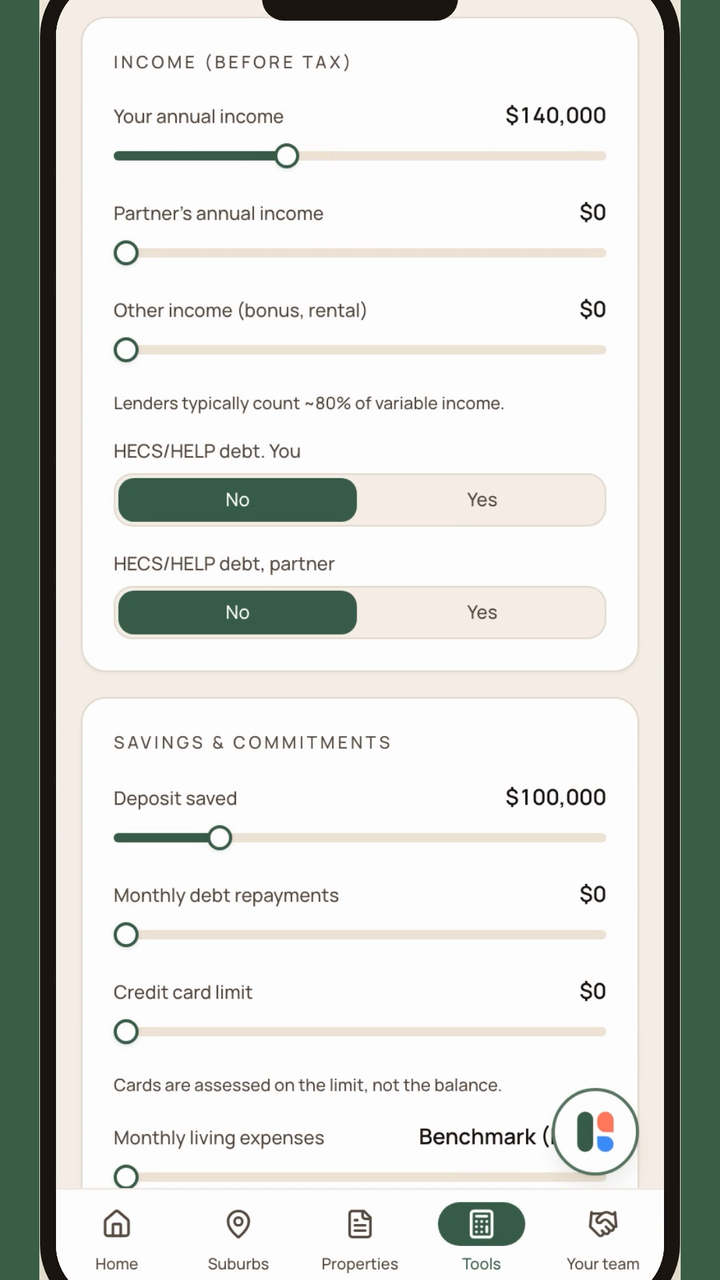
Here's what that looks like for Hannah and Leo. Suppose their lender works out that, after living costs and other debts, they can put $5,023 a month towards a loan at the assessment rate. That's exactly enough for $600,000 at 9.45% today.
Hold
- Illustrative loan rate
- 6.45%
- Assessment rate (plus 3 points)
- 9.45%
- Repayment tested by lender
- $5,023
- Illustrative borrowing power
- $600,000
- Change
- $0
Rise of 0.25 points
- Illustrative loan rate
- 6.70%
- Assessment rate (plus 3 points)
- 9.70%
- Repayment tested by lender
- $5,023
- Illustrative borrowing power
- $587,182
- Change
- -$12,818
That's a fall of about 2.1%. It's not a cliff. But if Hannah and Leo's pre-approval is set right at the top of their price range, $12,800 can be the difference between bidding to their limit and stopping one bid short.
Real lenders use their own expense measures, minimum assessment rates and income shading, so your figure will be different. Treat this as a way to understand direction and size, not a quote.
What should first home buyers do this week?
Whatever happens on Tuesday, these steps are worth doing before then.
- Check your pre-approval's expiry date. Pre-approvals don't last forever. Find the date on your letter. If it expires soon, or a rise lands, ask your broker or lender whether they'd re-assess you at the new rate and what your figure would be.
- Ask for your number at a higher rate now. Ask your broker: "If my rate went up 0.25 points, what would my approved amount be?" Then you aren't finding out the week of an auction.
- Build a buffer into your budget, not just the lender's. The lender's buffer is a test. Your buffer is real money. Moneysmart suggests working out costs as if rates rose by 3% (Moneysmart, as at 16 September 2026). See whether your weekly budget still works.
- Bring fixed vs variable questions to your broker. Useful ones: What's the fixed rate today, and for how long (Moneysmart says fixed periods are usually one to five years)? What are the break costs if I sell or refinance? Can I make extra repayments or have an offset? Would a split loan suit me?
- Set your bidding limit from your own numbers. Use the lower of your pre-approval and your own comfortable repayment. If a rise trims your borrowing power, your limit should move with it.
- Don't try to time the market. Waiting for a decision, or rushing to beat one, is a guess. The better question is whether this home works for your budget, household and plans at today's rate and at a higher one.
For more on the numbers behind borrowing, read how much a couple can borrow and mortgage broker vs lender for your first home.
Does a rate rise change stamp duty or first home buyer schemes?
No. A cash rate decision doesn't change Victorian stamp duty concessions, the First Home Owner Grant or the 5% Deposit Scheme. Those have their own rules and caps. What it can change is how much you can borrow, which can change which homes are within those caps for you. Our guides to first home buyer stamp duty in Victoria and first home buyer schemes in Australia cover the details.
What if you're planning on one income?
The same buffer applies, so the effect is proportionally similar. But on one income there's usually less room to absorb a higher repayment. Our guide on how much you can borrow on one income walks through it.
Where do you go from here?
If you're mid-search like Hannah and Leo, the useful habit is checking every home against your borrowing power at today's rate and a higher one, side by side with what you actually need from the home. Havenli's budget tools are built for that, and it launches in Victoria on 8 November 2026. You can join the free waitlist.
Sources
All sources checked as at 21 October 2026.
- Statement by the Monetary Policy Board: Monetary Policy Decision, Media Release 2026-27, Reserve Bank of Australia, 29 September 2026
- Cash Rate Target, Reserve Bank of Australia, as at 21 October 2026
- Media Releases 2026, Reserve Bank of Australia, as at 21 October 2026
- Board Meeting Schedules, Reserve Bank of Australia, as at 21 October 2026
- Statistical table F6, Housing Lending Rates, Reserve Bank of Australia and APRA, published 8 October 2026 (data to August 2026)
- APRA maintains current macroprudential policy settings in highly uncertain environment, APRA, 28 May 2026
- Choosing a home loan, ASIC Moneysmart, last updated 16 September 2026
Frequently asked questions
When is the RBA's November 2026 decision?
The Monetary Policy Board meets on 2 to 3 November 2026. The decision is published at 2:30pm AEDT on Tuesday 3 November, Melbourne Cup Day. Any change takes effect the next day.
How much would a 0.25 point rise add to a $600,000 loan?
On an illustrative variable rate rising from 6.45% to 6.70%, a $600,000, 30-year principal and interest loan goes from about $3,773 to about $3,872 a month, roughly $99 more. Your lender's rate and pass-through may differ.
How do interest rate rises affect borrowing power?
Lenders test whether you could repay at your loan rate plus a 3 percentage point buffer. When rates rise, that test rate rises too, so the same income supports a smaller loan. In our example, borrowing power falls from $600,000 to about $587,182.
Will my pre-approval change if rates go up?
It might. A pre-approval is assessed at the rates and policies at the time. Check your expiry date and ask your broker or lender whether a rate change would mean a re-assessment, and what your new figure would be.
Should I wait until after the decision to buy?
Nobody can reliably predict rate decisions. Rather than timing the market, check that the home works at today's rate and at a higher one, and set your bidding limit from those numbers. --- *General information only, not financial advice. Figures are illustrations based on the stated assumptions, not what any lender will offer you. Speak with a licensed broker or lender about your situation.* Ready to compare homes? Read our [first home buyer guide for Victoria](/blog/first-home-buyer-guide-victoria).
A friend in your corner while you buy your first home.
Havenli gives first home buyers honest, sourced answers, from your first listing scroll to the keys. Launching soon in Victoria.
Join the waitlist