Every upfront cost of buying a $600k home in Victoria, itemised (2026)
The full cost of buying a house in Victoria: deposit, stamp duty, registration fees, conveyancing, inspections and adjustments on a $600k first home.
The short answer: On a $600,000 established home, an eligible Victorian first home buyer pays no stamp duty. Your fixed government costs are the deposit ($30,000 at 5% or $120,000 at 20%), a transfer registration fee of $1,509 and a mortgage registration fee of $129.20 (both lodged electronically). On top of that, budget for conveyancing, inspections, lender fees, insurance, moving and settlement adjustments, which you should quote individually.
The price on the listing is not the cost. It's the biggest number, but it isn't the only one, and the smaller ones tend to arrive in the last few weeks when your savings are already stretched. This guide lists every upfront cost on a $600,000 purchase, who you pay, when you pay it and where the figure comes from.
Priya and Dan are first home buyers looking at a two-bedroom townhouse in Melbourne's west, priced at $600,000. They have $42,000 saved. They know about the deposit and that they won't pay stamp duty. What they want to know is: what else, and when? We'll follow their numbers through this guide. Priya and Dan are illustrative characters, not real people.
What are the upfront costs of buying a house in Victoria?
The Consumer Affairs Victoria (CAV) budgeting guide lists legal and conveyancing fees, loan establishment fees, land transfer duty, building and pest inspection fees and moving costs. Add the deposit, registration fees, lenders mortgage insurance (LMI), insurance and settlement adjustments, and you have the full list.
Some are set by law, so you can calculate them exactly. Others depend on who you hire and which lender you use, so the only honest figure is a quote.
How much deposit do you need on a $600,000 home?
5% deposit: $30,000. Under the Australian Government 5% Deposit Scheme, eligible first home buyers can buy with a minimum 5% deposit. From 1 October 2025, the Scheme has no income caps, no waitlists and no LMI. The property price cap for Victoria is $950,000 in Melbourne and Geelong, and $650,000 in other areas, as at 25 October 2026 (price caps page). Both the purchase price and the lender's valuation must be at or below the cap.
20% deposit: $120,000. Below this, lenders generally charge LMI unless the Scheme applies.
That's $90,000 less to save. The trade-off is a bigger loan ($570,000 instead of $480,000), so higher repayments and more interest. Our deposit guide goes deeper.
The deposit is usually paid when you sign, into a trust account, with the balance at settlement. The contract sets the amount, so if you only have 5%, raise it with your conveyancer before you sign.
How much stamp duty do you pay on a $600,000 first home in Victoria?
Nothing, if you're eligible. The State Revenue Office (SRO) says a first home buyer pays no duty on a home with a dutiable value up to $600,000, and a reduced amount from $600,001 to $750,000 (page updated 22 October 2026). It applies to new and established homes and to vacant land.
Key conditions: you're buying it to live in, at least one buyer is an Australian citizen, New Zealand citizen or permanent resident, and at least one of you lives there for 12 continuous months within 12 months of settlement. You're not eligible if you or your partner have already received a First Home Owner Grant or first home buyer duty relief, or have owned and lived in a home in Australia for at least 6 continuous months since 1 July 2000. Check the SRO page for the full list.
What it would cost without the exemption. Using the SRO's general duty rates for more than $130,000 to $960,000 ($2,870 plus 6% of the value above $130,000):
Calculation
$2,870 + 6% × ($600,000 - $130,000) = $2,870 + $28,200 = $31,070
That's what the exemption saves Priya and Dan. The SRO duty calculator returns the same $31,070 for a buyer who isn't a first home buyer (even if they'll live in the home, because the principal place of residence concession stops at $550,000), and $0 for an eligible first home buyer, as at 25 October 2026. For more detail, read how much stamp duty a first home buyer pays in Victoria.
What are the transfer and mortgage registration fees?
These are paid to Land Use Victoria to register you as the new owner and to register your lender's mortgage on the title. Your conveyancer usually collects them and pays them at settlement.
Transfer registration fee: $1,509. For 2026-27, the fee unit is $17.27 (Land Use Victoria, Customer Information Bulletin 241). Land Use Victoria's guide to Transfer of Land Act fees 2026-2027 (effective 1 July 2026) sets an electronic transfer on sale fee of $104.30 plus $2.34 for every whole $1,000 of the price, rounded up to the next whole dollar, up to a maximum of $3,614. Working:
Calculation
$104.30 + ($2.34 × 600) = $104.30 + $1,404 = $1,508.30, rounded up to $1,509
Mortgage registration fee: $129.20. The same guide sets $129.20 for a mortgage lodged electronically ($139.50 on paper).
Paper lodgment of a transfer costs a little more ($114.80 plus $2.34 per whole $1,000). You can also check your exact figures with Land Use Victoria's transfer of land fees calculator.
Do you pay lenders mortgage insurance with a 5% deposit?
LMI protects the lender, not you, if you can't repay. Lenders usually charge it when you borrow more than 80% of the value.
If you use the 5% Deposit Scheme, the government guarantees part of your loan to the lender, so you don't pay LMI. The Scheme page notes you must keep meeting its conditions (such as living in the home), or the lender may require LMI later.
If you borrow more than 80% without the Scheme, LMI varies by lender, loan size and deposit. Ask your lender or broker for a written quote. Our First Home Guarantee guide explains how the Scheme works.
How much are conveyancing fees in Melbourne?
Conveyancing fees aren't set by law, and we haven't found a primary source that publishes a reliable range, so we won't quote one. CAV recommends you engage your own legal practitioner or conveyancer, get written quotes from several, and discuss all disbursements (the administrative costs, such as title and certificate searches, passed on to you).
Practical approach: get 2 to 3 written quotes, and ask each one whether the price includes contract and section 32 review before you sign, searches, and settlement. Check conveyancers on CAV's public register of licensed conveyancers. If you want to know what they'll be checking, read our section 32 checklist.
What other upfront costs should you budget for?
Building and pest inspection. CAV advises considering a professional building inspection before you sign, plus a pest inspection for termites. Prices vary, so get quotes.
Loan application and valuation fees. Some lenders charge them; others don't. Compare them across loan offers.
Building insurance. CAV notes your lender will recommend building insurance from the date the contract is signed. For a townhouse, the owners corporation's policy may already cover the building, so check before you double up.
Moving and connections. Removalists, power, gas, internet and water setup. Get quotes a few weeks ahead.
Settlement adjustments. The cost most first home buyers don't see coming. CAV explains that rates and other outgoings are adjusted at settlement: the seller pays up to and including settlement day, and you from the next day. If the seller has prepaid the year's council rates or a quarter's water, you reimburse them for the days after settlement. Your conveyancer's statement of adjustments shows the exact amount.
Owners corporation fees. For units and many townhouses, these are adjusted the same way. Check the owners corporation certificate in the section 32 for fees and any special levy, which can mean a large one-off bill.
The full table: every upfront cost on a $600,000 home
See this yourself inside Havenli
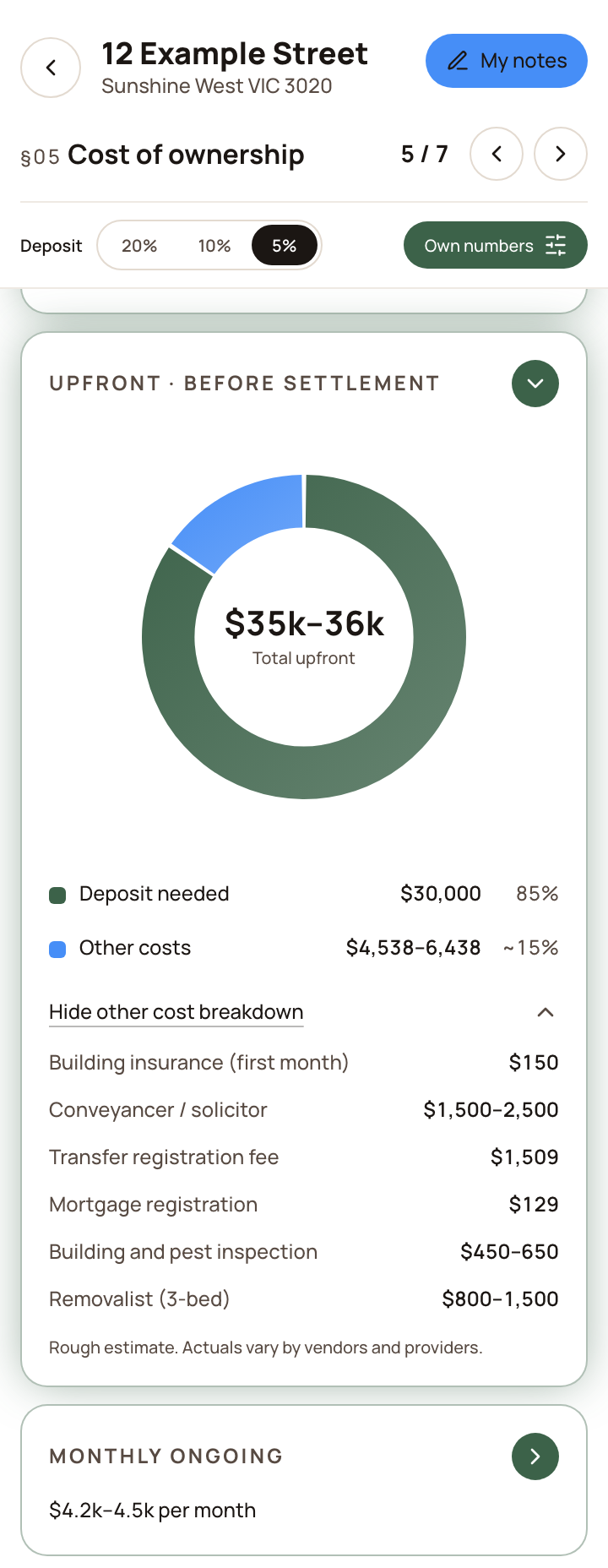
Amounts are for an eligible first home buyer buying a $600,000 established home, as at 25 October 2026.
Deposit (5% Deposit Scheme)
- Typical amount or rule
- $30,000
- Who you pay
- Agent's or conveyancer's trust account
- When
- On signing the contract
- Source
- firsthomebuyers.gov.au
Deposit (20%)
- Typical amount or rule
- $120,000
- Who you pay
- Agent's or conveyancer's trust account
- When
- On signing the contract
- Source
- Calculation
Stamp duty
- Typical amount or rule
- $0 if eligible ($31,070 if not)
- Who you pay
- SRO, via your conveyancer
- When
- At settlement (up to 3 months after)
- Source
- SRO calculator and rates
Principal place of residence concession
- Typical amount or rule
- Not available at $600,000 (only applies up to $550,000)
- Who you pay
- Not applicable
- When
- Not applicable
- Source
- SRO PPR concession page
Transfer registration fee
- Typical amount or rule
- $1,509 (electronic)
- Who you pay
- Land Use Victoria, via conveyancer
- When
- At settlement
- Source
- Land Use Victoria fee guide 2026-2027
Mortgage registration fee
- Typical amount or rule
- $129.20 (electronic)
- Who you pay
- Land Use Victoria, via conveyancer or lender
- When
- At settlement
- Source
- Land Use Victoria fee guide 2026-2027
LMI
- Typical amount or rule
- $0 with the 5% Deposit Scheme; otherwise varies by lender, ask for a quote
- Who you pay
- Your lender
- When
- Usually added at settlement
- Source
- firsthomebuyers.gov.au
Conveyancing and disbursements
- Typical amount or rule
- Not set by law: get 2 to 3 written quotes
- Who you pay
- Your conveyancer or lawyer
- When
- Part upfront, balance at settlement
- Source
- CAV
Building and pest inspection
- Typical amount or rule
- Varies: get quotes
- Who you pay
- Your inspector
- When
- Before you sign or bid
- Source
- CAV
Loan application and valuation fees
- Typical amount or rule
- Varies by lender, can be $0
- Who you pay
- Your lender
- When
- At application or settlement
- Source
- CAV
Building insurance
- Typical amount or rule
- Varies: get quotes (check owners corporation cover)
- Who you pay
- Your insurer
- When
- From contract signing
- Source
- CAV
Moving and connections
- Typical amount or rule
- Varies: get quotes
- Who you pay
- Removalist and utility providers
- When
- Around settlement
- Source
- CAV
Council rates and water adjustment
- Typical amount or rule
- Pro rata share of what the seller prepaid
- Who you pay
- Seller, via settlement statement
- When
- At settlement
- Source
- CAV
Owners corporation fee adjustment
- Typical amount or rule
- Pro rata share of prepaid fees, plus any special levy
- Who you pay
- Seller or owners corporation
- When
- At settlement
- Source
- Section 32 OC certificate
Priya and Dan's numbers. Their fixed costs are the $30,000 deposit, $1,509 for the transfer and $129.20 for the mortgage, so $31,638.20 before quotes. That leaves about $10,360 of their $42,000 for everything else. Their quotes will tell them whether that's enough, or whether to keep saving a few more months.
How do the costs change at $650,000 or $750,000?
The registration fees rise slightly with the price. Stamp duty is where the real jump happens, because the first home buyer concession tapers off between $600,001 and $750,000.
Working, using the SRO general rate ($2,870 plus 6% of the value above $130,000):
- $650,000: full duty would be $2,870 + 6% × $520,000 = $34,070. The SRO calculator returns $11,356 for an eligible first home buyer. That matches the concession formula in section 57JA of the Duties Act 2000: $34,070 × ($650,000 - $600,000) ÷ $150,000 = $11,356.67, which the calculator shows as $11,356.
- $750,000: full duty is $2,870 + 6% × $620,000 = $40,070. The SRO calculator returns $40,070 for an eligible first home buyer, because $40,070 × $150,000 ÷ $150,000 = $40,070. At the top of the range, the concession has tapered to nothing.
Transfer fees, using Land Use Victoria's electronic formula: $104.30 + ($2.34 × 650) = $1,625.30, rounded up to $1,626; $104.30 + ($2.34 × 750) = $1,859.30, rounded up to $1,860.
$600,000
- 5% deposit
- $30,000
- Stamp duty (eligible first home buyer)
- $0
- Transfer fee (electronic)
- $1,509
- Mortgage fee (electronic)
- $129.20
$650,000
- 5% deposit
- $32,500
- Stamp duty (eligible first home buyer)
- $11,356
- Transfer fee (electronic)
- $1,626
- Mortgage fee (electronic)
- $129.20
$750,000
- 5% deposit
- $37,500
- Stamp duty (eligible first home buyer)
- $40,070
- Transfer fee (electronic)
- $1,860
- Mortgage fee (electronic)
- $129.20
Duty figures from the SRO calculator for an established home, contract date 25 October 2026 (a new home returns the same figures); fees from Land Use Victoria's 2026-2027 fee guide. So a $50,000 higher price adds $13,973 to Priya and Dan's upfront cash ($2,500 more deposit, $11,356 duty and $117 more in transfer fees), before they borrow a cent more. Note that $650,000 is also the 5% Deposit Scheme cap outside Melbourne and Geelong.
What is the principal place of residence concession, and does it apply to you?
The principal place of residence (PPR) concession is a lower stamp duty rate for anyone buying a home to live in, not just first home buyers. The SRO says you can get it if you:
- buy a property valued up to $550,000
- move in within 12 months of settlement
- use it as your home for 12 straight months (if you buy with others, at least one of you must live there).
It also applies to vacant land valued up to $550,000 that you'll build your home on. Your conveyancer claims it on the Digital Duties Form as part of the transfer.
The rates. From the SRO's PPR current rates (updated 29 September 2026) and general rates (updated 29 September 2026), as at 25 October 2026:
Up to $25,000
- General rate
- 1.4% of the value
- PPR concession rate
- 1.4% of the value
- Saving
- $0
More than $25,000 to $130,000
- General rate
- $350 plus 2.4% of the value above $25,000
- PPR concession rate
- $350 plus 2.4% of the value above $25,000
- Saving
- $0
More than $130,000 to $440,000
- General rate
- $2,870 plus 6% of the value above $130,000
- PPR concession rate
- $2,870 plus 5% of the value above $130,000
- Saving
- 1% of the value above $130,000
More than $440,000 to $550,000
- General rate
- $2,870 plus 6% of the value above $130,000
- PPR concession rate
- $18,370 plus 6% of the value above $440,000
- Saving
- $3,100
More than $550,000
- General rate
- General rates
- PPR concession rate
- Not available
- Saving
- $0
Worked example. Sam owned and lived in an apartment for three years in his twenties, then sold it. He's now buying a $500,000 unit to live in. Because he has already owned and lived in a home for more than 6 months, he isn't eligible for the first home buyer exemption, but he does qualify for PPR. Sam is an illustrative character, not a real person.
- PPR rate: $18,370 + 6% × ($500,000 - $440,000) = $18,370 + $3,600 = $21,970
- General rate: $2,870 + 6% × ($500,000 - $130,000) = $2,870 + $22,200 = $25,070
- Saving: $25,070 - $21,970 = $3,100
The SRO calculator returns $21,970 with the PPR box ticked and $25,070 without it, as at 25 October 2026. His transfer fee would be $104.30 + ($2.34 × 500) = $1,274.30, rounded up to $1,275.
Does it stack with the first home buyer exemption? No, and in practice you never have to choose. Under section 57JA of the Duties Act 2000, the first home buyer exemption and concession are relief on a home you'll live in (a "PPR transfer"), and the price bands don't overlap: PPR rates stop at $550,000, while the first home buyer concession only starts at $600,001. Up to $600,000, an eligible first home buyer pays $0, which beats any PPR rate. The SRO's PPR page says the same thing plainly: the concession is available to anyone, and if you're a first home buyer, you pay no duty on homes up to $600,000. The SRO pages don't describe a "greater benefit" test between the two (they do for the separate pensioner duty reduction).
When would a first home buyer rely on PPR instead? Only if you don't meet the first home buyer requirements and the price is $550,000 or less. That includes buyers who think of themselves as first home buyers but aren't under the rules, for example if you or your partner owned and lived in a home for 6 continuous months or more after 1 July 2000, or have already received a First Home Owner Grant or first home buyer duty relief.
It won't help above $750,000. Once you pass the end of the first home buyer concession, the PPR cap of $550,000 is already well behind you, so you pay general rates: $40,070 at $750,000, or $43,070 at $800,000 ($2,870 + 6% × $670,000), with or without the PPR box ticked. And if Priya had owned a home before, their $600,000 townhouse would attract the full $31,070, because $600,000 is above the PPR limit.
Off the plan. For a non-first home buyer buying a home to live in, SRO's standard off-the-plan concession uses the same $550,000 PPR threshold, applied after construction costs are deducted.
What changes for new homes and off-the-plan?
First Home Owner Grant. The SRO confirms the grant is $10,000 for eligible new homes in Victoria valued up to $750,000 (updated 29 September 2026). It doesn't apply to established homes like Priya and Dan's townhouse. See our First Home Owner Grant guide.
Stamp duty on new homes. The first home buyer exemption and concession apply the same way (the SRO calculator returns the same figures for a new home). CAV notes duty applies to the GST-inclusive price of a new property.
Off-the-plan. The SRO's off-the-plan concession can lower the dutiable value by deducting construction costs incurred after you sign. A temporary version for strata apartments, units and townhouses covers contracts signed from 21 October 2024 to before 21 April 2027. The standard SRO calculator doesn't include it, so ask the vendor for the off-the-plan value and have your conveyancer confirm the duty. CAV says an off-the-plan deposit can't exceed 10% of the price.
Upfront costs vs ongoing costs: what's the difference?
Upfront costs are paid once, around signing and settlement. Ongoing costs start the day after settlement: loan repayments (the RBA raised the cash rate target to 4.60% on 29 September 2026, with its next decision due on 3 November 2026), council rates, water, insurance, owners corporation fees and maintenance.
A home that's affordable upfront can still be tight every month. Comparing homes by total cost of ownership, not just price, is the clearest way to see that.
How can you get your real numbers before you buy?
Start with the fixed figures in this guide, then collect quotes for everything marked "varies". Keep a single list with the date of each quote.
If you'd rather see it in one place, Havenli's budget screen brings together your borrowing power, the schemes you may be eligible for and an estimate of your upfront costs, so you can test a $600,000 home against a $650,000 one before you fall for either. It launches on 8 November 2026, and you can join the free waitlist.
Sources
All sources checked as at 25 October 2026.
- First home buyer duty exemption or concession, State Revenue Office (updated 22 October 2026), as at 25 October 2026
- Principal place of residence duty concession, State Revenue Office (updated 22 October 2026), as at 25 October 2026
- Land transfer duty: principal place of residence (current rates), State Revenue Office (updated 29 September 2026), as at 25 October 2026
- Land transfer duty: non-principal place of residence (current rates), the general rates, State Revenue Office (updated 29 September 2026), as at 25 October 2026
- Land transfer (stamp) duty calculator, State Revenue Office (updated 22 October 2026), results for $500,000, $600,000, $650,000, $750,000 and $800,000, contract date 25 October 2026, as at 25 October 2026
- First Home Owner Grant (current rates), State Revenue Office (updated 29 September 2026), as at 25 October 2026
- Understanding the off-the-plan duty concession, State Revenue Office (updated 22 October 2026), as at 25 October 2026
- Duties Act 2000, version 141 (sections 57J and 57JA), Victorian Legislation (incorporating amendments as at 24 June 2026), as at 25 October 2026
- Customer Information Bulletin 241 (fee unit $17.27 from 1 July 2026), Land Use Victoria (page last updated 3 June 2026), as at 25 October 2026
- Guide to Transfer of Land Act fees 2026-2027, Land Use Victoria (effective 1 July 2026), as at 25 October 2026
- Australian Government 5% Deposit Scheme, Housing Australia (no update date shown), as at 25 October 2026
- 5% Deposit Scheme property price caps, Housing Australia (no update date shown), as at 25 October 2026
- Planning to buy property (budget before you buy), Consumer Affairs Victoria (last updated 7 May 2021), as at 25 October 2026
- Seek expert advice on property, Consumer Affairs Victoria (last updated 3 May 2021), as at 25 October 2026
- Inspect properties before you buy, Consumer Affairs Victoria (last updated 23 April 2026), as at 25 October 2026
- Before property settlement, Consumer Affairs Victoria (last updated 9 September 2022), as at 25 October 2026
- Settlement, Consumer Affairs Victoria (last updated 9 April 2026), as at 25 October 2026
- Buying off the plan, Consumer Affairs Victoria (last updated 8 May 2021), as at 25 October 2026
- Monetary policy decision, 29 September 2026 (media release 2026-27), Cash rate target and Board meeting schedules, Reserve Bank of Australia, as at 25 October 2026
Frequently asked questions
How much does it cost to buy a $600,000 house in Victoria as a first home buyer?
If you're eligible for the exemption, there's no stamp duty. With a 5% deposit ($30,000), a transfer fee of $1,509 and a mortgage fee of $129.20 (both electronic), your fixed costs are about $31,638. Then add conveyancing, inspections, lender fees, insurance, moving and settlement adjustments from your own quotes.
Do first home buyers pay stamp duty in Victoria?
Not on homes up to $600,000 if eligible. From $600,001 to $750,000 you pay reduced duty, for example $11,356 at $650,000 according to the SRO calculator. Above $750,000, full duty applies at general rates.
What is the principal place of residence concession in Victoria?
A lower duty rate for anyone buying a home to live in, on properties valued up to $550,000. You must move in within 12 months of settlement and live there for 12 straight months. It saves up to $3,100, for example $21,970 instead of $25,070 at $500,000. It doesn't apply above $550,000, and an eligible first home buyer won't need it, because they pay $0 up to $600,000.
What are the hidden costs of buying a house?
The ones buyers most often miss are settlement adjustments for council rates, water and owners corporation fees, lender application and valuation fees, LMI if you borrow more than 80% without the 5% Deposit Scheme, and special levies in an owners corporation.
Do I pay LMI with the 5% Deposit Scheme?
No. The Scheme removes LMI for eligible buyers within the price cap ($950,000 in Melbourne and Geelong, $650,000 elsewhere in Victoria). If you stop meeting its conditions, your lender may require LMI.
How much are conveyancing fees in Melbourne?
They aren't set by law and vary between providers. Consumer Affairs Victoria recommends getting written quotes from several conveyancers or lawyers and asking about disbursements. Get 2 to 3 quotes before you sign anything.
When do I pay each cost?
The deposit when you sign, inspections before you sign or bid, and most other costs (duty, registration fees, conveyancing balance and adjustments) at settlement. Duty can be paid up to three months after settlement, but title won't transfer until it's paid. --- *General information only, not financial advice. General information only, not legal advice. Have a licensed conveyancer or solicitor review your contract.* Once you've signed, here's [what happens between offer and settlement](/blog/after-your-offer-is-accepted-settlement-victoria).
A friend in your corner while you buy your first home.
Havenli gives first home buyers honest, sourced answers, from your first listing scroll to the keys. Launching soon in Victoria.
Join the waitlist